Gambling & Trading Addiction: When the Stock Market Becomes a Casino
“I just need one big trade to recover my losses.” “The market was against me today, but tomorrow I have a strategy.”
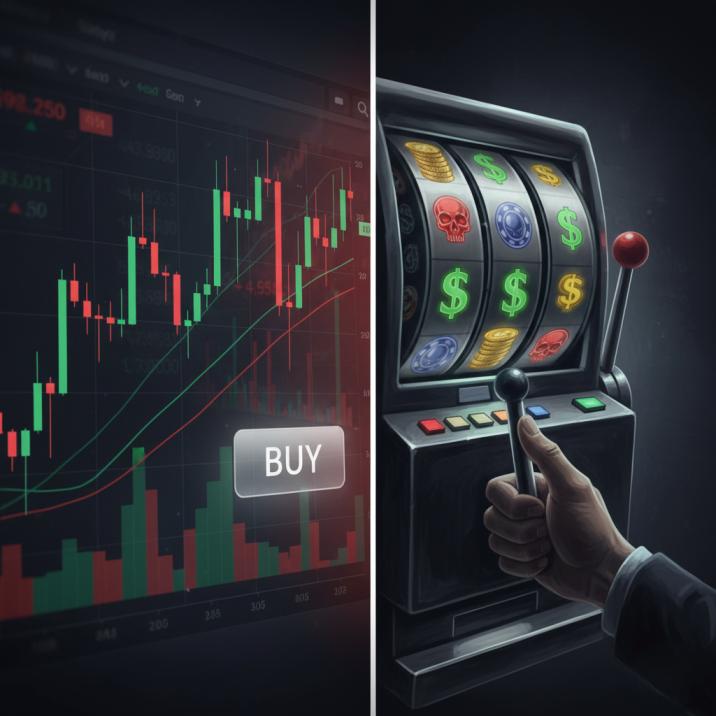
If you walk into a casino and bet your house on Red, people call you an addict. But if you open a Demat account and bet your savings on Nifty Futures, people call you a “Trader.”
In India, the explosion of easy trading apps has blurred the line between Investing and Gambling. Many young professionals aren’t “building wealth”; they are chasing a dopamine high. They are glued to the screen from 9:15 AM to 3:30 PM, heart racing, palms sweating, losing lakhs while convincing their families they are “learning the market.”
As a psychologist, I am here to tell you the hard truth: If you are trading for the thrill, you are not an investor. You are a gambler.
The Science: The Slot Machine in Your Pocket
Why is F&O (Futures & Options) so addictive? It uses the exact same psychological mechanism as a slot machine: Variable Ratio Reinforcement.
- Predictability is boring: If you got a salary every day, you wouldn’t be excited.
- Uncertainty is addictive: In trading, you win sometimes, and you lose sometimes. You never know when the win is coming. When you see a green candle shoot up, your brain releases a massive hit of Dopamine. When you see a red candle, your brain doesn’t just feel sad; it feels deprived, pushing you to trade again to get that high back.
4 Signs You Are a Gambler, Not an Investor
Be honest with yourself. How many of these apply to you?
1. The “Revenge Trading” Loop You lose ₹10,000 in the morning. Instead of closing the laptop, you double your position size to “recover the loss” by 3 PM. Investing: Logical, long-term. Gambling: Emotional, desperate to break even today.
2. The Preoccupation You are at dinner with your family, but you are checking the SGX Nifty or US markets on your phone. You dream about charts. You wake up anxious about the market opening. If the market dictates your mood for the day, you are addicted.
3. Ignoring the “Stop Loss” (Sunk Cost Fallacy) You set a stop loss, but when the price hits it, you delete it. You think, “It will turn around. I just need to wait.” You hold onto losing trades hoping for a miracle, but you sell winning trades instantly because you are terrified the profit will vanish.
4. Concealment Do you hide your losses from your spouse? Do you lie about how much capital you have wiped out? Secrecy is the hallmark of addiction.
The “Sunk Cost” Trap
Why can’t you stop? Because you have already lost so much. The Sunk Cost Fallacy tells you: “If I quit now, that ₹5 Lakhs is gone forever. If I keep playing, I might win it back.” The Reality: The market does not owe you your money back. Continuing to trade with a “recovery mindset” usually leads to wiping out the remaining capital.
How to Break the Cycle
1. The “Cold Turkey” Detox You cannot “trade in moderation” if you are an addict.
- Delete the apps.
- Change your passwords and give them to a trusted friend/spouse.
- Block the websites. You need at least 30 days away from the charts to reset your dopamine baseline.
2. Calculate the “Real” ROI Look at your P&L (Profit & Loss) statement for the last 3 years. Not the “big wins,” but the net total. Most traders are net negative. Seeing the hard data can sometimes break the delusion that “I am profitable.”
3. Replace the Rush You will feel bored without the market volatility. You need a healthy replacement for adrenaline.
- High-intensity exercise (Running, Boxing).
- Competitive sports. You need to channel that energy somewhere that doesn’t cost you your life savings.
Do You Need Help?
- Test Your Severity (PsychKit): Are you a problem gambler? Take the PGSI (Problem Gambling Severity Index). It’s a harsh reality check. Take the Gambling Addiction Test
- The Urge to Revenge Trade (VentOut): When you take a big loss and feel the urge to double down, STOP. Log onto VentOut. Tell a listener: “I just lost money and I want to gamble.” Talking about the shame reduces the urge to act on it. Pause and Chat Before You Trade
- Financial & Psychological Repair (IndianPsychologists): Gambling addiction often requires professional help because the financial ruin leads to severe depression and suicidal thoughts. Find a therapist who specializes in De-addiction. Find a Gambling Addiction Specialist
Final Thought
The stock market is a machine designed to transfer money from the impatient to the patient. If you are trading for excitement, you are paying a very expensive entry fee. Your worth is not defined by your P&L statement. You can stop. You can rebuild. But first, you have to admit the game is over.
📚 References & Further Reading
- Kahneman, Daniel – Thinking, Fast and Slow (Loss Aversion & Sunk Cost).
- Fenton-O’Creevy, Mark – Traders: Risks, Decisions, and Management in Financial Markets.
- Gamblers Anonymous – Recovery Steps.

Author: JOYSON JOY P' MPhil (Cli. Psy.) Clinical Psychologist
Joyson Joy P is a Clinical Psychologist (RCI Licensed) and the Chief Mentor advisor of the Indian Psychologists Directory & Magazine. With a deep focus on Trauma, Anxiety, Depression, Personality disorders, and Adult ADHD, he bridges the gap between complex psychological science and the Indian cultural context. His mission is to make evidence-based mental healthcare accessible, de-stigmatized, and easy to navigate for every Indian.