Panic Attacks at Work: A 5-Minute Emergency Guide to Calming Down
It usually happens out of nowhere.
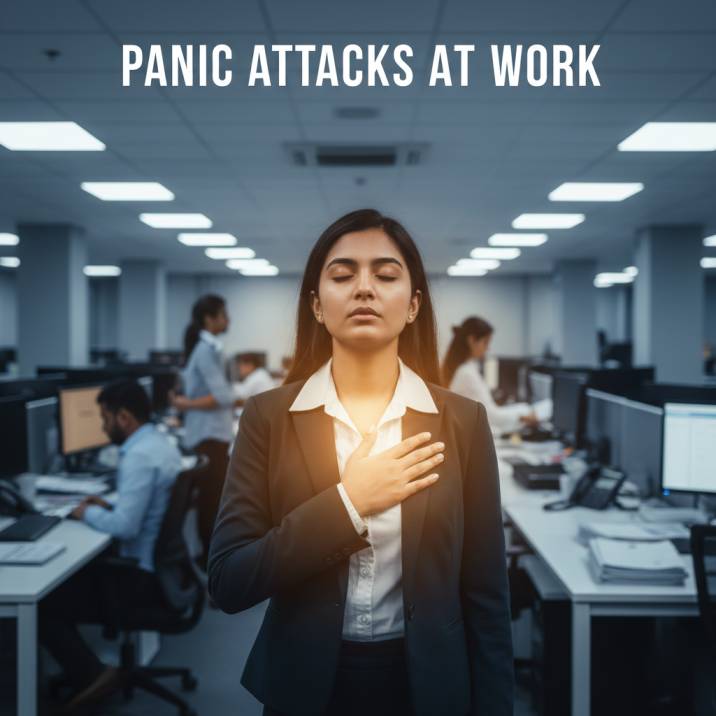
You are sitting in a conference room, listening to a presentation. Or maybe you are just staring at an Excel sheet. Suddenly, the room feels hot. Your heart starts hammering against your ribs like a trapped bird. Your hands go numb. You feel a terrifying wave of doom wash over you.
“Am I having a heart attack? Am I going to faint right here in front of my boss?”
If this sounds familiar, you are not dying. You are having a Panic Attack.
Having a panic attack is terrifying anywhere, but having one at work adds a layer of deep shame. You worry about your professional image. You worry about being seen as “weak.”
As a Clinical Psychologist, I want to tell you two things:
- You are not weak; your nervous system is just overheated.
- You can stop this. Right now.
Here is your 5-Minute Emergency Protocol to regain control.
Minute 1: The Exit Strategy (Don’t Fight It)
The worst thing you can do is sit in that chair and try to “act normal.” Your brain is screaming “DANGER,” and fighting it only makes the adrenaline spike higher.
- The Move: Excuse yourself. You don’t need a big explanation.
- The Script: “I need to grab some water,” or “I’ll be right back, just using the restroom.”
- The Destination: Go to the washroom, a stairwell, or your car. Find a place where you don’t feel “watched.” Removing the social pressure immediately drops the anxiety by 20%.
Minute 2: Hijack Your Breath (Box Breathing)
When you panic, you hyperventilate (short, shallow breaths). This dumps too much oxygen into your blood, which causes the dizziness and tingling hands. You need to reset CO2 levels.
We use a technique used by Navy SEALs called Box Breathing.
Shutterstock
- Inhale through your nose for 4 seconds.
- Hold that breath for 4 seconds.
- Exhale through your mouth for 4 seconds (like you are blowing out a candle).
- Hold empty for 4 seconds.
Do this 4 times. This physically forces your Vagus Nerve to switch from “Fight or Flight” to “Rest and Digest.”
Minute 3: The “5-4-3-2-1” Grounding Technique
Now that your lungs are working, we need to bring your brain back to reality. Your mind is stuck in a catastrophe (“I’m dying”). We need to bring it back to the room.
Look around you and name these things (say them out loud if you are alone):
- 5 things you can SEE: The tiles on the floor. The soap dispenser. The reflection in the mirror. A crack in the wall. The color of your shirt.
- 4 things you can TOUCH: The cold tap water. The fabric of your pants. The wall. Your own wrist.
- 3 things you can HEAR: The AC humming. Distant traffic. Someone walking outside.
- 2 things you can SMELL: The soap. Your perfume/cologne.
- 1 thing you can TASTE: The lingering taste of coffee/tea, or just your own mouth.
This forces your prefrontal cortex (the thinking brain) to come online and shuts down the Amygdala (the panic brain).
Minute 4: The “Cold Shock” (Optional but Effective)
If you are in a washroom, turn the tap to the coldest setting. Splash freezing water on your face, or run your wrists under the cold water for 30 seconds. Why? This triggers the “Mammalian Dive Reflex,” which instantly slows down your heart rate. It is a biological hack that works almost every time.
Minute 5: The Return (Re-entry)
You are still shaking. That is okay. It’s just leftover adrenaline leaving your system.
- Check your posture: Shoulders down. Unclench your jaw.
- The Self-Talk: “That was just a false alarm. My body thought there was a tiger, but there isn’t. I am safe. I am capable.”
- Go back: Walk back to your desk. Sip some water. You don’t need to dive back into deep work immediately. Do a low-stakes task (like organizing emails) for 10 minutes until you feel fully grounded.
“Panic is a sudden desertion of us, and a going over to the enemy of our imagination.” — Christian Nestell Bovee
Why Is This Happening to Me?
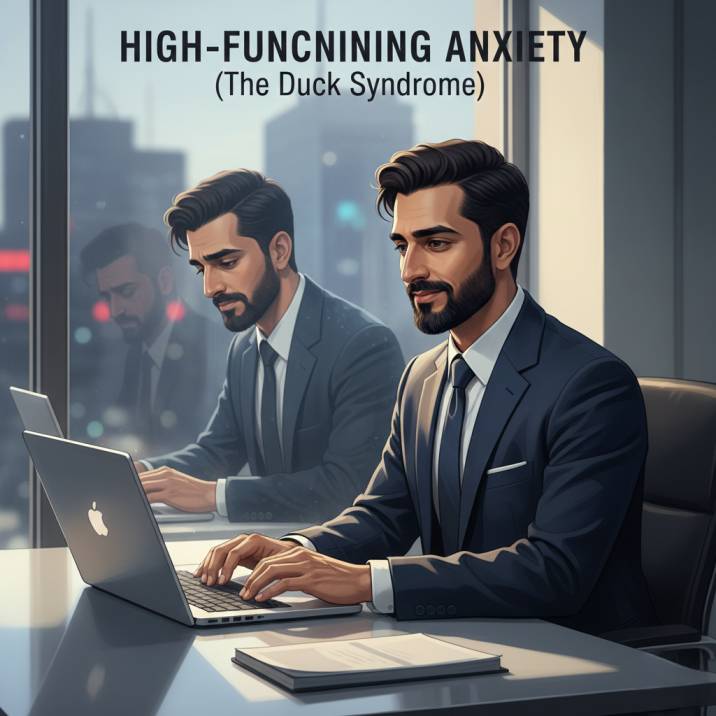
A panic attack at work isn’t usually about that specific moment. It is often the result of months of suppressed stress, burnout, or “High-Functioning Anxiety.” Your “Stress Bucket” finally overflowed.
If this is happening frequently, it is a signal. Your body is filing a protest.
Long-Term Solutions (Don’t Ignore the Signal)
1. Immediate Support (VentOut.org): If you are too shaken to go back to work, or if you feel a panic attack building up before a meeting, don’t wait.
- Log into VentOut and chat with a Wellness Listener. Just typing out “I feel like I’m going to panic” can deflate the fear. It’s discreet—you can do it from your desk. Chat Discreetly on VentOut
2. Assess Your Severity (PsychKit.org): Is this a one-time thing, or do you have Panic Disorder? Take a standardized test to understand your symptom severity. Take the Free Anxiety/Panic Test
3. Clinical Treatment (IndianPsychologists.in): Panic Disorder is highly treatable. CBT (Cognitive Behavioral Therapy) is the gold standard. A Clinical Psychologist can teach you how to “retrain” your brain so these attacks stop happening. Find an Anxiety Specialist Near You
Final Reminder
You are not “crazy.” You are just a human being with a nervous system that is trying to protect you a little too hard. You handled it. You are safe. Now, take a deep breath and carry on.
📚 References & Further Reading
- Mayo Clinic – Panic attacks and panic disorder: Symptoms & causes.
- NHS UK – Coping with panic attacks.
- Harvard Health – Understanding the stress response.

Author: JOYSON JOY P' MPhil (Cli. Psy.) Clinical Psychologist
Joyson Joy P is a Clinical Psychologist (RCI Licensed) and the Chief Mentor advisor of the Indian Psychologists Directory & Magazine. With a deep focus on Trauma, Anxiety, Depression, Personality disorders, and Adult ADHD, he bridges the gap between complex psychological science and the Indian cultural context. His mission is to make evidence-based mental healthcare accessible, de-stigmatized, and easy to navigate for every Indian.