
Financial Anxiety: How to Stop Worrying About Money and Start Planning
It is the end of the month. Your phone pings with a message: “Your Account XX123 has been debited…” Your heart drops. Your stomach tightens. You quickly swipe the notification away because looking at it makes you feel sick.
Or maybe you are the opposite. You check your banking app five times a day. You have savings, but you are terrified that one medical emergency or one recession will wipe you out. You live like a miser even though you earn well.
This is Financial Anxiety. In India, we don’t talk about money openly. We talk about status (brand new cars, lavish weddings), but we rarely talk about the fear behind the scenes.
As a psychologist, I can tell you: Money problems are rarely just about math. If they were, a calculator would solve them. Money problems are about Safety, Worth, and Control.
It’s Not About Being “Broke”
You can be a millionaire and still have financial anxiety.
- Being Broke is a math problem (Income < Expenses).
- Financial Anxiety is an emotional problem (Fear > Reality).
It is a chronic sense of dread that something bad is about to happen to your security. It keeps you up at 3 AM wondering, “What if I lose my job?” even when you just got a promotion.
The Root: What is Your “Money Script”?
We learn about money before we learn algebra. Your relationship with money was shaped by your parents. We call these Money Scripts. Which one are you?
- The Avoider:“Money is scary/bad.”
- Childhood: Maybe your parents fought about money constantly.
- Result: You ignore bills, don’t invest, and hope things “work themselves out.”
- The Worshipper:“Money will solve everything.”
- Childhood: Maybe you felt powerless or poor growing up.
- Result: You work yourself to burnout to accumulate more, believing the next lakh will finally make you happy.
- The Vigilante:“You must save every penny.”
- Childhood: You saw a financial disaster (bankruptcy/loss).
- Result: You have money, but you can’t enjoy a coffee without feeling guilty.
The “Ostrich Effect” (Avoidance)
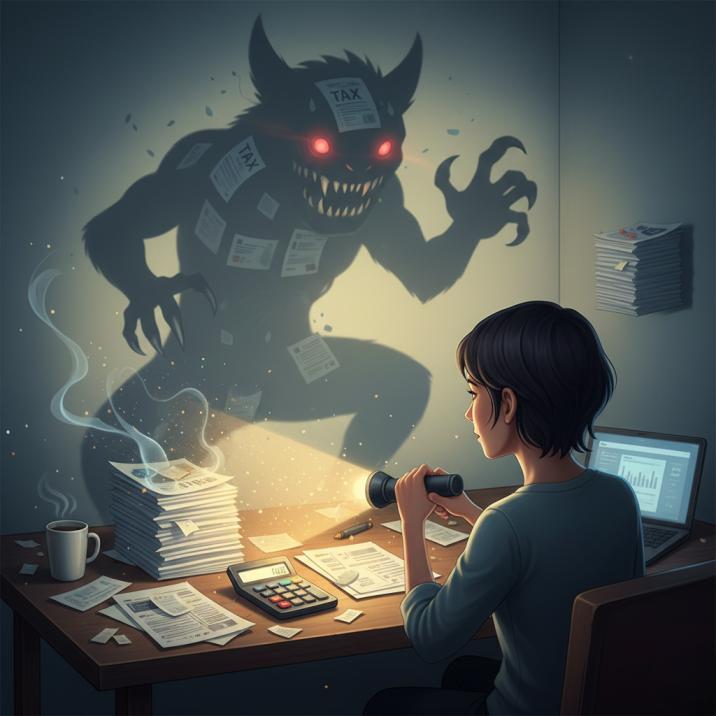
The most common symptom I see is Avoidance. When we are anxious, our brain’s solution is: “If I don’t see it, it’s not there.” So you don’t open the credit card statement. You don’t check your PF balance. But this creates a Monster in the Closet. The less you look at the monster, the bigger and scarier it grows in your imagination.
How to Fix It (Therapy for Your Wallet)
You need to move from “Emotional Reacting” to “Logical Planning.”
1. Exposure Therapy (The “Money Date”)
You cannot fix what you cannot face. Set aside 30 minutes this week. Not to solve everything, but just to Look.
- Open all your accounts.
- Write down the total debt.
- Write down the total savings.
- The Goal: Just getting the numbers on paper reduces anxiety by 50%. Monsters shrink when you turn the lights on.
2. Automate to Reduce Decision Fatigue
Anxiety loves uncertainty. If you have to decide to save every month, you will hesitate.
- The Fix: Set up an SIP (Systematic Investment Plan) or auto-debit on the 1st of the month.
- When the decision is made automatically, your brain stops obsessing over it. You create safety by default.
3. Separate “Net Worth” from “Self Worth”
This is the hardest one. In India, your bank balance is often treated as your report card for life. Remind yourself: “My value as a human being, as a father, as a friend, does not drop when the market drops.”
You Don’t Have to Carry the Calculator Alone
If money keeps you awake at night, you need support—emotional and practical.
- Vent the Panic (VentOut): If you just lost money in the stock market or are drowning in EMI stress, talking helps. Our Wellness Listeners can help you calm the panic attack so you can think straight again. Calm Down Before You Plan
- Is it Anxiety or Reality? (PsychKit): Are you stressed because you are actually in danger, or because you have Generalized Anxiety? Take the test to differentiate. Take the Stress Assessment
- Deep Money Trauma (IndianPsychologists): If your fear of poverty is rooted in childhood trauma, a financial advisor can’t help you—but a therapist can. Find a Counselling Psychologist to rewrite your Money Script. Find a Therapist for Money Anxiety
Final Thought
Money is a tool, like a hammer. You can use it to build a house, or you can use it to hit yourself in the head. Stop hitting yourself. Look at the numbers. Make a plan. And remember, you have survived 100% of your bad days so far—even the ones where you were broke.
📚 References & Further Reading
- Klontz, B., & Klontz, T. – Mind Over Money: Overcoming the Money Disorders That Threaten Our Financial Health.
- Housel, Morgan – The Psychology of Money.
- Journal of Financial Therapy – The Association Between Financial Anxiety and Financial Literacy.

Author: JOYSON JOY P' MPhil (Cli. Psy.) Clinical Psychologist
Joyson Joy P is a Clinical Psychologist (RCI Licensed) and the Chief Mentor advisor of the Indian Psychologists Directory & Magazine. With a deep focus on Trauma, Anxiety, Depression, Personality disorders, and Adult ADHD, he bridges the gap between complex psychological science and the Indian cultural context. His mission is to make evidence-based mental healthcare accessible, de-stigmatized, and easy to navigate for every Indian.