Toxic In-Laws and Boundaries: Keeping Your Peace Without Breaking the Family
In India, there is a famous saying: “You don’t just marry a person; you marry a family.”
It sounds romantic in movies. In real life, it often feels like you married a committee that has an opinion on everything—from how much salt you put in the dal to when you should have a baby.
For many women (and increasingly men), the relationship with in-laws is the single biggest source of stress. You feel trapped. If you speak up, you are “disrespectful.” If you stay silent, you lose your self-respect.
As a psychologist, I want to tell you something important: You can respect your elders and respect yourself at the same time. They are not mutually exclusive.
Here is how to survive the “Great Indian Family Drama” without losing your mind.
Step 1: Diagnosis – Is it “Toxic” or Just “Annoying”?
First, let’s be objective. Living with people from a different generation is always hard.
- Annoying: Your mother-in-law commenting that you wake up late on Sundays.
- Toxic: Your mother-in-law telling your husband that you are “ruining the family” or constantly comparing you to others to make you feel small.
Annoying requires Patience. Toxic requires Boundaries.
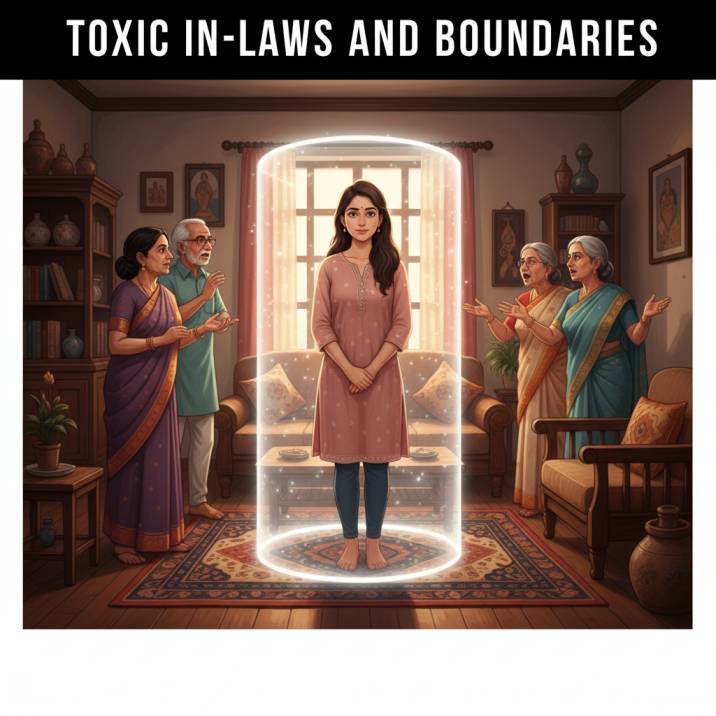
Step 2: The “Soft Wall” Technique (Emotional Boundaries)
In a Western country, the advice is often “Move out” or “Cut them off.” In India, that isn’t always practical or desired. So, we use the Soft Wall.
A Soft Wall means you are physically present, but emotionally detached.
The “Grey Rock” Method: When a toxic person tries to provoke you, do not react. Be as boring as a grey rock.
- Mother-in-law: “The neighbors’ daughter-in-law cooks so well. You always order from Swiggy.”
- Your Old Reaction: (Defending) “But Mom, I work 10 hours a day! I don’t have time!” (This starts a fight).
- The Grey Rock Reaction: “Hmm, that is true. She is a good cook.” (And then you walk away).
When you stop feeding them the “Drama” (emotion), they eventually stop poking you because it’s no longer fun.
Step 3: The “Partner Buffer” (Crucial for Husbands)
This section is for the husbands. Gentlemen, you are the Bridge between your parents and your wife. If the bridge is weak, the whole structure collapses.
The Rule: Your parents are your responsibility.
- If your wife has an issue with your mother, you need to speak to your mother.
- It should not be: “Mom, Priya says you are interfering.”
- It should be: “Mom, I think we need to give Priya some space in the kitchen.”
When you take the hit, it protects the relationship between the two women. When you step back, you force them into a war.
Step 4: Physical Boundaries (The Sanctuary)
If you live in a joint family, you need a Sanctuary. Usually, this is your bedroom.
- Rule: When the bedroom door is closed, nobody enters without knocking. This must be a non-negotiable rule established early on.
- Rule: You are not available 24/7. It is okay to say, “I am going to read for an hour,” and disappear. You don’t need to be “ON” duty all the time.
Step 5: Where to Release the Poison
You cannot keep swallowing anger. It will turn into acidity, migraines, or depression. You need a safe outlet.
- Don’t Vent to Your Husband (Always): If you complain about his mother every day, eventually he will get defensive. He loves her too.
- Vent to a Neutral Party (VentOut): This is exactly why we built VentOut. You need a place to scream, cry, and complain about your in-laws without destroying your marriage. Our listeners are trained to validate your feelings so you can go back home feeling lighter. Vent About Family Stress Here
- Couples Therapy (The Last Resort): If the in-law issue is threatening a divorce, do not wait. A Clinical Psychologist can act as a mediator. We help the husband understand the wife’s pain and help the wife understand the husband’s helpless position, so you can become a team again. Find a Couples Therapist
Final Thought
You cannot change people who don’t want to change. You cannot “fix” your in-laws. But you can fix your boundaries. Your peace of mind is not a negotiation. It is a requirement. Protect it fiercely.
📚 References & Further Reading
- Minuchin, S. – Families and Family Therapy (Structural Family Therapy).
- Gottman, J. – The Seven Principles for Making Marriage Work (In-law conflict section).
- Indian Journal of Clinical Psychology – Dynamics of the Joint Family System.

Author: JOYSON JOY P' MPhil (Cli. Psy.) Clinical Psychologist
Joyson Joy P is a Clinical Psychologist (RCI Licensed) and the Chief Mentor advisor of the Indian Psychologists Directory & Magazine. With a deep focus on Trauma, Anxiety, Depression, Personality disorders, and Adult ADHD, he bridges the gap between complex psychological science and the Indian cultural context. His mission is to make evidence-based mental healthcare accessible, de-stigmatized, and easy to navigate for every Indian.