The “Log Kya Kahenge” Syndrome: Overcoming Social Anxiety in India
If you grew up in an Indian household, you have heard this phrase more often than “I love you.”
- “Don’t wear that dress, Log Kya Kahenge?“
- “Don’t choose Arts over Engineering, Log Kya Kahenge?“
- “Don’t get divorced, Log Kya Kahenge?“
Translation: What will people say?
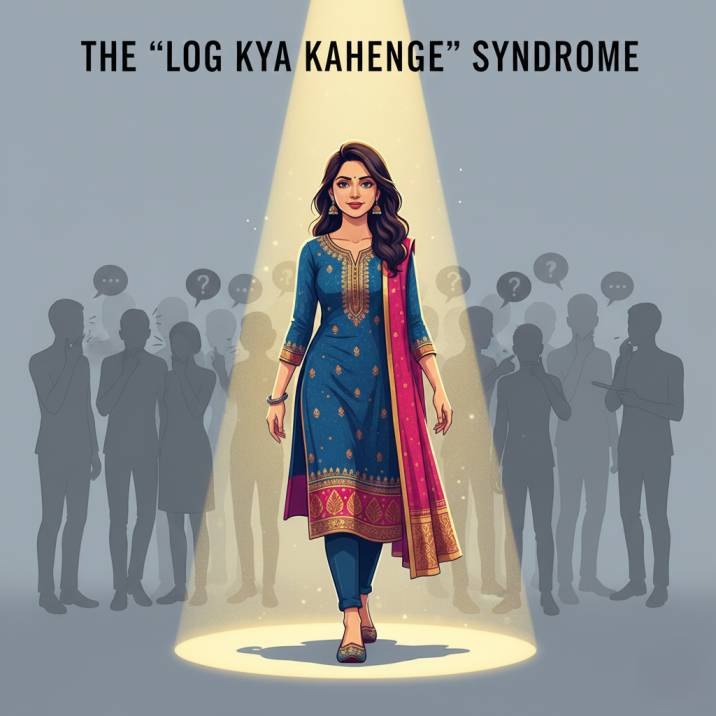
It is the unofficial motto of the Indian middle class. We are raised to believe that an invisible jury of “Chaar Log” (four people) is constantly watching us, grading our performance, and waiting for us to slip up.
While this keeps society “disciplined,” for many individuals, it morphs into a suffocating mental cage known as Social Anxiety Disorder.
Is It Culture or Is It Clinical?
There is a fine line. Cultural Pressure is when you feel annoyed that your aunties are gossiping about your marriage. You dislike it, but you still do what you want. Social Anxiety is when that fear of judgment is so paralyzing that you stop living. You avoid parties, you don’t speak up in meetings, or you agree to a marriage you don’t want—all to avoid the possibility of criticism.
The Psychology: The “Spotlight Effect”
In psychology, we call this the Spotlight Effect. You walk into a wedding hall and you feel like a massive spotlight is following you. You think everyone is noticing that your saree drape is slightly off, or that you look tired.
The Reality Check: Here is the brutal, liberating truth: People are not thinking about you. They are thinking about themselves. That Aunty you are scared of? She is worrying about her daughter-in-law or her knee pain. The “Log” are too busy with their own “Log Kya Kahenge” anxiety to actually judge you for more than 5 seconds.
3 Steps to Break the “LKK” Loop
You cannot silence society, but you can lower the volume. Here is how we treat this in therapy (CBT).
1. Name the “Log” (The Fact Check)
When your brain says, “Everyone will laugh,” ask yourself: “Who is everyone?” Take a pen. Write down the names. Usually, “Society” turns out to be just two people: Maybe your judgmental uncle and a neighbor you don’t even like. Once you realize you are sacrificing your happiness for Sharma Ji from Block B, the fear looks silly.
2. The “So What?” Technique
Play the worst-case scenario movie to the end.
- Thought: “If I quit my job to start a bakery, people will say I failed.”
- Question: “Okay, and then?”
- Answer: “They will gossip at one dinner party.”
- Question: “And then?”
- Answer: “They will eat their dinner and go home.”
- Question: “Will your bank account freeze? Will you stop breathing?”
- Answer: “No.”
Fear thrives in the vague. It dies in the specifics.
3. Practice “Micro-Rebellions” (Exposure Therapy)
You don’t need to do something drastic today. Start small.
- Wear a shirt that is slightly “too bright” for a family function.
- Speak up in a meeting even if your voice shakes.
- Post a photo on Instagram where you don’t look perfect.
Every time you survive a “Micro-Rebellion” without the world ending, your brain learns: I am safe.
Do You Need Professional Help?
If this fear is stopping you from functioning (e.g., you can’t attend interviews, you can’t eat in public), you might have Social Anxiety Disorder. This is a medical condition, not a personality quirk.
- The Gold Standard Treatment: CBT (Cognitive Behavioral Therapy) is incredibly effective for this. A Clinical Psychologist helps you “rewire” these automatic thoughts. Find a Social Anxiety Expert
- Practice in a Safe Sandbox (VentOut): The best way to beat social anxiety is exposure. Start by talking to strangers who cannot judge you because they don’t know you. Our VentOut listeners are trained to be neutral and supportive. It’s the perfect practice ground. Practice Talking on VentOut
- How Severe Is It? Take the Liebowitz Social Anxiety Scale (a standard clinical test) to see where you stand. Check Your Anxiety Score
Final Thought
The “Chaar Log” who you are so worried about? They won’t be there to pay your hospital bills when you get sick from stress. They won’t live your unlived life for you. Live for yourself. Let them talk. It gives them something to do.
📚 References & Further Reading
- Gilovich, T., et al. – The Spotlight Effect in Social Judgment.
- Indian Journal of Psychiatry – Cultural factors in social anxiety disorder.
- Mayo Clinic – Social anxiety disorder (social phobia).

Author: JOYSON JOY P' MPhil (Cli. Psy.) Clinical Psychologist
Joyson Joy P is a Clinical Psychologist (RCI Licensed) and the Chief Mentor advisor of the Indian Psychologists Directory & Magazine. With a deep focus on Trauma, Anxiety, Depression, Personality disorders, and Adult ADHD, he bridges the gap between complex psychological science and the Indian cultural context. His mission is to make evidence-based mental healthcare accessible, de-stigmatized, and easy to navigate for every Indian.