Overthinking Loop: How to Finally Turn Off Your Brain at Night
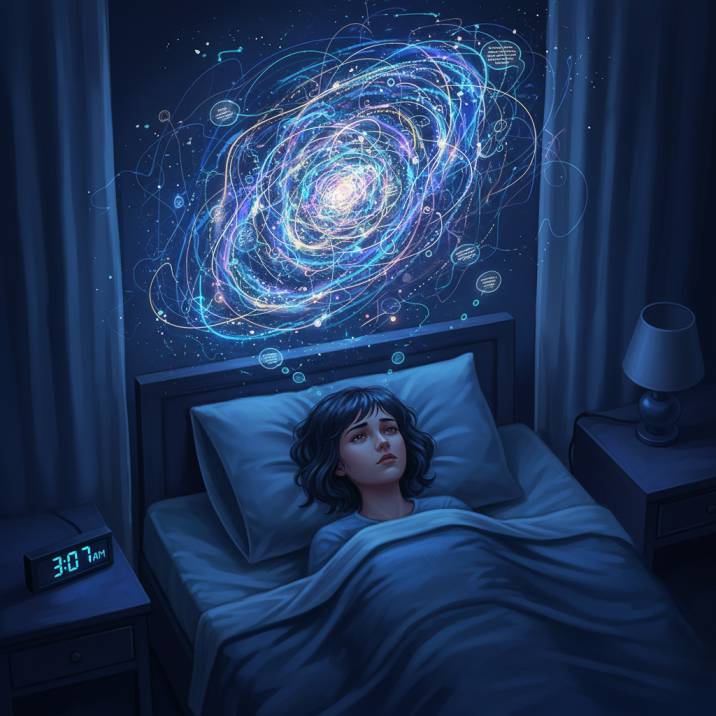
It is 11:30 PM. You are exhausted. Your body is heavy. You turn off the lights, pull up the blanket, and close your eyes.
And then, ping.
Your brain wakes up.
- “Did I lock the front door?”
- “Why did I say that stupid thing in the meeting today?”
- “What if my parents get sick?”
- “I have to pay the electricity bill tomorrow.”
Suddenly, it is 2 AM. You are wide awake, staring at the fan spinning above you, trapped in a loop of “What Ifs.”
In India, we call this “Faltu ki Chinta” (Useless Worry), but clinically, it is a sign of a hyperactive Default Mode Network (DMN). When the outside world gets quiet, your internal world gets loud.
You are not alone. Nighttime anxiety is the most common complaint I hear in my clinic. Here is why it happens and, more importantly, how to hit the “OFF” button.
Why Does the Brain Attack You at Night?
During the day, you are distracted. Work, traffic, Instagram, chores—your brain is busy processing external data. At night, the distractions disappear. The silence creates a vacuum. Your brain finally has “free time” to process all the emotions you suppressed during the day.
Basically, your brain is saying: “Hey, you didn’t pay attention to this stress at 10 AM because you were busy, so let’s deal with it now.”
Strategy 1: The “Brain Dump” (Do This at 9 PM)
You cannot stop the thoughts, but you can schedule them. Most people try to solve their life problems while lying in bed. That is a mistake. Your bed is for sleeping, not planning.
The Technique: At least 2 hours before bed (say, 9 PM), take a notebook and a pen. Write down every single thing that is worrying you.
- Project deadline.
- Mom’s knee pain.
- Car service due.
Once it is on paper, your brain feels safe. It knows, “Okay, it is written down. I don’t need to keep reminding you.” This clears the RAM of your mental computer.
Strategy 2: Cognitive Shuffling (The Magic Trick)
If you are already in bed and spiraling, do not try to “empty your mind.” That is impossible. instead, you need to scramble it.
This technique is called Cognitive Shuffling. It tricks your brain into entering the “dream state.”
- Pick a random word. Let’s say “BOMBAY.”
- Start with B. Visualize words starting with B. Ball. Bear. Baby. Bus. (Don’t create a story, just visualize the image).
- Move to O. Owl. Orange. Onion.
- Move to M. Monkey. Money. Moon.
Why it works: Overthinking requires logical, coherent focus. Random visualization breaks that logic chain. It bores your brain to sleep.
Strategy 3: The 20-Minute Rule (Stop Fighting)
If you have been tossing and turning for 20 minutes, GET UP.
Staying in bed while anxious creates a psychological link: Bed = Anxiety. You want your brain to link Bed = Sleep.
- Get out of the bedroom.
- Go to the living room. Keep the lights dim.
- Read a boring book (finance magazines work great) or listen to soothing music.
- Do NOT touch your phone. Blue light is the enemy.
- Return to bed only when your eyelids feel heavy.
Strategy 4: Talk It Out Before Bed
Sometimes, writing isn’t enough. You need to hear a human voice to feel safe.
- VentOut.org (The Night Shift): If you are lonely or stressed at night, our Wellness Listeners are available. A 15-minute chat can sometimes be enough to “pop the balloon” of stress so you can sleep peacefully. Chat with a Listener Before Bed
When Is It Insomnia?
If this happens to you more than 3 nights a week for 3 months, it is no longer just “stress.” It might be Chronic Insomnia.
Pills are not the only answer. The gold standard treatment is CBT-I (Cognitive Behavioral Therapy for Insomnia). It is a structured program that retrains your sleep drive without medication.
- Find a Sleep Specialist: Search for Clinical Psychologists who specialize in Sleep Disorders or CBT-I on our verified directory. Find a Sleep Therapist
- Check Your Sleep Quality: Are you just stressed or is it a sleep disorder? Take a quick check. Take the Insomnia Assessment
Final Thought
Sleep is not a luxury. It is the mechanic that fixes your body every night. Treat your sleep with the same respect you treat your job. Put the phone away, dump the thoughts on paper, and give yourself permission to rest.
📚 References & Further Reading
- Walker, M. – Why We Sleep: Unlocking the Power of Sleep and Dreams.
- Beaudoin, L. P. – The Science of Cognitive Shuffling (mySleepButton).
- National Sleep Foundation – Sleep Hygiene Guidelines.

Author: JOYSON JOY P' MPhil (Cli. Psy.) Clinical Psychologist
Joyson Joy P is a Clinical Psychologist (RCI Licensed) and the Chief Mentor advisor of the Indian Psychologists Directory & Magazine. With a deep focus on Trauma, Anxiety, Depression, Personality disorders, and Adult ADHD, he bridges the gap between complex psychological science and the Indian cultural context. His mission is to make evidence-based mental healthcare accessible, de-stigmatized, and easy to navigate for every Indian.