
What Actually Happens in the First Session? Breaking the Silence
The hardest step in therapy isn’t the crying. It isn’t the payment. It is the moment you put your hand on the door handle of the clinic (or click “Join Meeting”) for the very first time.
Your heart is pounding. What will I say? Will they judge me? Will they just stare at me silently like in the movies?
Today, I want to demystify this hour. And importantly, I want to help you understand who you are meeting, because in India, under the new NCAHP Act 2021, you have more specialized options than ever before.
Step 1: Who is Sitting Across from You? (It Matters!)
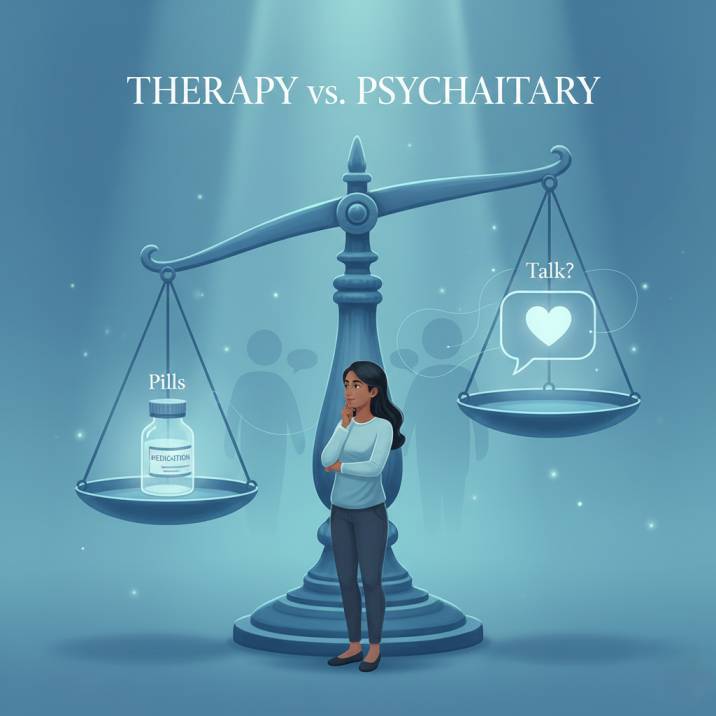
Before we talk about what happens, we need to talk about who is in the room. Many people think they always need a “Clinical Psychologist” (RCI Licensed). But that is like going to a heart surgeon when you just want to improve your cardio fitness.
Depending on your needs, you might be seeing one of two types of experts:
1. The Behavioural Health / Counselling Psychologist (NCAHP Recognized)
- Their Superpower: Prevention & Mild Issues.
- Best For: Relationship issues, breakup pain, career confusion, academic stress, mild anxiety, and “feeling stuck.”
- Why Choose Them: These professionals (recognized under the National Commission for Allied and Healthcare Professions Act) are trained to help you navigate life. They focus on wellness, not illness. If you want to optimize your life, build better habits, or resolve a conflict, they are often the most effective and affordable choice.
- The Vibe: Collaborative, solution-focused, and often more “conversational.”
2. The Clinical Psychologist (RCI Licensed)
- Their Superpower: Diagnosis & Treatment of Disorders.
- Best For: Deep-rooted trauma, OCD, chronic depression, personality disorders, or complex pathologies.
- Why Choose Them: If your symptoms are stopping you from functioning (eating, sleeping, working), you need this level of clinical intervention.
- The Vibe: Clinical, structured, and deeply analytical.
“The curious paradox is that when I accept myself just as I am, then I can change.” — Carl Rogers
Step 2: The First 10 Minutes (The “Ice-Breaker”)
Whether you choose a Counselling Psychologist or a Clinical one, the first 10 minutes are usually the same. We know you are nervous.
- The Introduction: We will introduce ourselves and explain Confidentiality. This is crucial. We legally cannot share what you say (unless you are at risk of harming yourself or others).
- The “Presenting Problem”: We will ask a simple question: “So, what brings you here today?” or “How have things been lately?”
- Your Job: You don’t need a rehearsed speech. You can just say, “I don’t know, I just feel heavy,” or “My husband and I can’t stop fighting.” Start anywhere. The therapist’s job is to connect the dots, not yours.
Step 3: The Middle (The Assessment)
Here is where the paths diverge slightly based on who you are seeing.
- If you are with a Counselling Psychologist: They will focus on the “Here and Now.” They will ask about your daily routine, your sleep, your recent stressors, and your support system. They are looking for patterns in your behavior that are causing you pain.
- Example: “You mentioned you feel angry when you come home. Let’s look at what happens in the 30 minutes before you leave the office.”
- If you are with a Clinical Psychologist: They might dive a bit deeper into your History. They need to rule out biological or deep-seated psychological causes. They might ask about your childhood, family history of mental illness, or physical symptoms.
- Example: “How long have you felt this lack of energy? Does it happen at the same time every year?”
Step 4: The End (The “Takeaway”)
A good first session shouldn’t leave you hanging. By the end of the hour, you should have three things:
- Validation: A feeling that “Okay, I am not crazy. This is a real problem with a name.”
- A Rough Plan: The therapist should tell you how they plan to help. “We will use CBT to manage your overthinking,” or “We will focus on conflict resolution skills for your marriage.”
- Homework (Maybe): You might get a small task. A breathing exercise, a journaling prompt, or just a goal to sleep by 11 PM.
Common Fears (Busted)
- “Will I have to talk about my childhood immediately?” No. Especially with Counselling Psychologists, we often start with your current problem. We only go back if it’s necessary to move forward.
- “Will they force me to take medicine?” Neither Clinical nor Counselling Psychologists can prescribe medicine. Only a Psychiatrist can do that. If we think you need it, we will suggest you see one, but the choice is always yours.
Ready to Start?
The most successful people in the world—athletes, CEOs, and artists—use psychologists not because they are “sick,” but because they want to be better.
- For Life Challenges & Growth: Connect with our verified Counselling & Behavioural Health Psychologists. They are the experts in getting you unstuck. Find a Counselling Psychologist
- For Clinical Disorders: If you feel your symptoms are severe, search for our RCI-licensed Clinical Psychologists. Find a Clinical Psychologist
- Start with a Free Check-up: Not sure which one you need? Take our quick assessment to see if your stress is “mild” (Counselling) or “clinical” (Clinical). Take the Free Assessment on PsychKit
📚 References & Further Reading
- National Commission for Allied and Healthcare Professions (NCAHP) Act, 2021 – Official Gazette of India.
- American Psychological Association (APA) – Understanding the difference between Clinical and Counselling Psychology.
- Sommers-Flanagan, J., & Sommers-Flanagan, R. – Clinical Interviewing.

Author: JOYSON JOY P' MPhil (Cli. Psy.) Clinical Psychologist
Joyson Joy P is a Clinical Psychologist (RCI Licensed) and the Chief Mentor advisor of the Indian Psychologists Directory & Magazine. With a deep focus on Trauma, Anxiety, Depression, Personality disorders, and Adult ADHD, he bridges the gap between complex psychological science and the Indian cultural context. His mission is to make evidence-based mental healthcare accessible, de-stigmatized, and easy to navigate for every Indian.