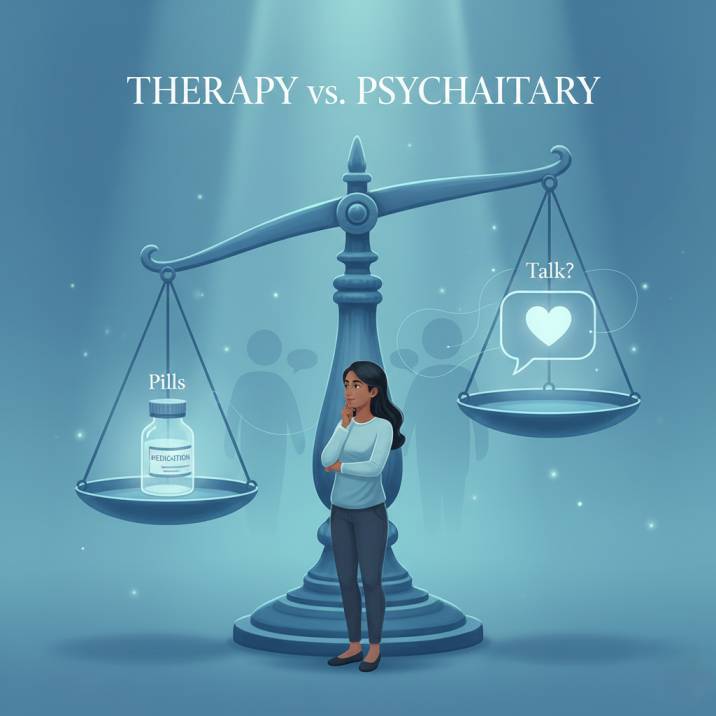
Therapy vs. Psychiatry: Do I Need Pills or Just Someone to Talk To?
One of the most common questions I get in my clinic usually comes in a hushed whisper. A patient will look at me, nervous, and ask: “Sir, do I need medicines? Will I get addicted?”
There is a huge confusion in India about the difference between a “mental doctor” (Psychiatrist) and a Psychologist. And because of this confusion, many people delay getting help. They are terrified that walking into a clinic means being put on heavy sedatives for the rest of their lives.
Let’s clear the air. Let’s look at your mind like a house.
The Hardware vs. The Software
The easiest way to understand the difference is to think of your brain as a computer.
A Psychiatrist is a Hardware Specialist. They are medical doctors (MBBS + MD/DPM). They understand the biology of the brain—the chemicals, the neurons, the “wiring.” If the fan in your computer is broken or the circuit is overheating, you need a hardware engineer. Similarly, if your brain chemistry is severely imbalanced (like in Schizophrenia, Bipolar Disorder, or severe Depression), you need a Psychiatrist to fix the biology with medication.
A Psychologist is a Software Specialist. We are trained in human behavior, thoughts, and emotions (M.Phil/PhD). If your computer is working fine physically, but you have installed a virus (negative thinking), or you have too many tabs open (anxiety), or the operating system is outdated (childhood trauma), fixing the hardware won’t help. You need to reprogram the software. That is what therapy does.
“The mind is its own place, and in itself can make a heaven of hell, a hell of heaven.” — John Milton
The “Dawa” (Medicine) Stigma in India
In our culture, we are often okay with taking a pill for a headache or diabetes, but taking a pill for the mind feels like a defeat. We worry: “Will I become a zombie?” or “Will people say I am paagal (mad)?”
Here is the truth: Medicine is not a failure of character. It is a tool.
For some people, their anxiety is so high that they physically cannot sit still in a therapy chair. Their heart is racing, and they can’t focus. In these cases, medication acts like a “brake.” It slows the car down enough so that the driver (you) can actually steer it using therapy.
So, Who Should You Visit First?
This is the golden rule I tell my patients:
Go to a Psychologist First If:
- You are dealing with life stress (job loss, breakups, family fights).
- You feel sad or anxious, but you can still function (go to work, shower, eat).
- You want to understand why you feel this way and learn skills to change it.
- You are struggling with habits, confidence, or relationships.
Go to a Psychiatrist First If:
- You are hearing voices or seeing things others don’t.
- You have thoughts of self-harm or suicide that feel uncontrollable.
- You cannot sleep for days, or you cannot get out of bed at all.
- Your mood swings are extreme (super high energy to deep despair) without any reason.
The “Gold Standard”: Why Not Both? Research consistently shows that for many conditions, the best treatment is a combination. Medicine calms the storm; therapy teaches you how to sail the ship. We often work together. I frequently refer patients to psychiatrists for a short course of meds, and they refer patients to me for CBT (Cognitive Behavioral Therapy).
Finding the Right Support System
You don’t have to figure this out alone. We have built an ecosystem to help you at every stage of this journey.
- For Verified Clinical Experts: If you know you need professional, licensed care, search our directory for RCI-registered Clinical Psychologists who can diagnose and treat complex issues. Find a Clinical Psychologist
- For Flexible Support (VentOut): Not everyone needs a clinical diagnosis right away. Maybe you just need to vent, or maybe you need guidance on a specific life hurdle. VentOut.org is unique because it offers a full range of support:
- Listeners: For when you just need a human connection.
- Counsellors: Master’s level experts for guidance and counseling.
- Clinical Psychologists: For when deep, clinical work is required. You can choose exactly the level of expertise that fits your pocket and your problem. Explore Support Options at VentOut
- Curious About Your Symptoms? If you are still unsure if what you are feeling is “normal” or “clinical,” take a standardized test to see where you stand. Take a Free Depression/Anxiety Test
Bottom Line
You don’t fix a broken leg by “thinking positive,” and you don’t fix a chemical imbalance by “trying harder.” There is no shame in needing help—whether that help comes in the form of a capsule or a conversation. The only shame is suffering in silence when solutions are right here.
📚 References & Further Reading
- Cuijpers, P., et al. (2014). Adding psychotherapy to antidepressant medication in depression and anxiety disorders: a meta-analysis. World Psychiatry.
- Indian Psychiatric Society (IPS) – Guidelines on Clinical Practice.
- National Institute of Mental Health (NIMH) – Mental Health Medications: What You Need to Know.

Author: JOYSON JOY P' MPhil (Cli. Psy.) Clinical Psychologist
Joyson Joy P is a Clinical Psychologist (RCI Licensed) and the Chief Mentor advisor of the Indian Psychologists Directory & Magazine. With a deep focus on Trauma, Anxiety, Depression, Personality disorders, and Adult ADHD, he bridges the gap between complex psychological science and the Indian cultural context. His mission is to make evidence-based mental healthcare accessible, de-stigmatized, and easy to navigate for every Indian.