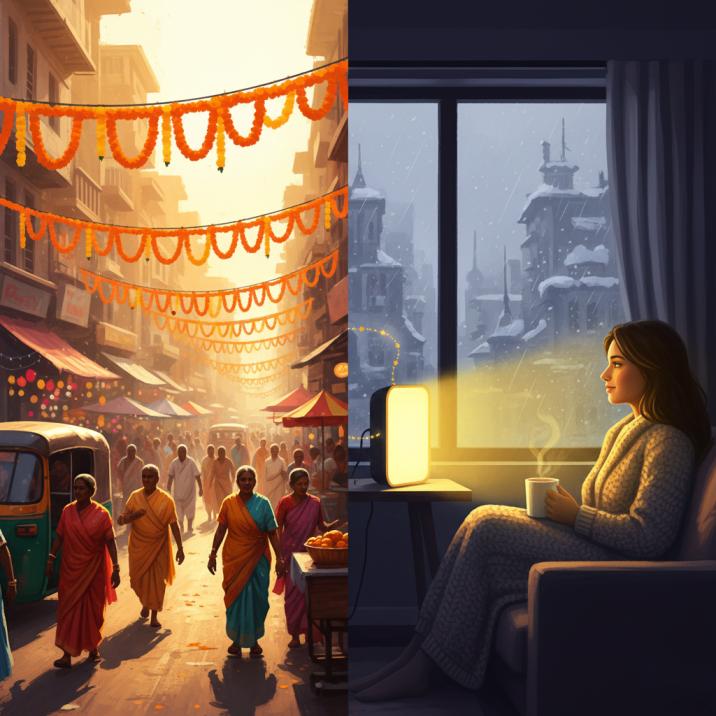

Finding a Culturally Competent Therapist: Why You Need Someone Who Understands Context
You finally built up the courage to go to therapy. You sit down. You tell the therapist about how overwhelmed you are by your mother-in-law’s constant interference or your father’s pressure to get married.
The therapist looks at you and says: “Why don’t you just move out?” or “You need to set a strict boundary and tell them to stop.”
You freeze. You think: “If I could ‘just move out,’ I wouldn’t be paying you ₹2000 to listen to me.” You leave the session feeling misunderstood, or worse—like you are weak for not being able to do the “logical” thing.
This is not your fault. This is a lack of Cultural Competence. Psychology textbooks are mostly written in the West (US/Europe). They are designed for Individualist societies. India is a Collectivist society. Using a Western map to navigate an Indian road will only get you lost.
Here is why you need a therapist who understands the “Desi Context.”
The “Western” vs. “Indian” Mindset Clash
In the West, the unit of psychological health is the Individual.
- Goal: Independence, Self-Actualization, Personal Happiness.
- Pathology: “Enmeshment” (being too close to parents).
In India, the unit of psychological health is often the Family.
- Goal: Harmony, Duty (Dharma), Interdependence.
- Pathology: Isolation (being cut off from the tribe).
If a therapist treats you like a Western individual, they will view your family obligations as “toxic.” A Culturally Competent Therapist understands that in India, your identity is woven into your relationships. They won’t ask you to cut the threads; they will help you untangle the knots.
3 “Desi” Blind Spots Bad Therapists Miss
1. The “Log Kya Kahenge” Anxiety A generic therapist might say: “Who cares what people think? Ignore them.” A competent therapist knows that in India, social reputation is a survival currency. You can’t just “ignore” it without consequences. They will help you navigate the judgment, not pretend it doesn’t exist.
2. The “Guilt” of Boundaries In the West, a boundary is a wall. “Do not enter.” In India, a boundary has to be a curtain. It needs to be soft. If you use Western assertion (“Mom, stop it”), it is seen as aggression. A good therapist teaches you “Respectful Assertion”—how to say “No” without sounding ungrateful.
3. The Complexity of Arranged Marriage A bad therapist hears “Arranged Marriage” and thinks “Forced/Backward.” A good therapist understands it is a valid relationship model based on shared values and family integration, and helps you navigate the unique pressure of getting to know a stranger after the engagement.
How to Interview Your Therapist (The “Vibe Check”)
You are hiring them. You are allowed to interview them. Don’t just ask about their degree. Ask about their lens.
Ask these 3 Questions:
- “How do you view joint family dynamics?”
- Red Flag: “I believe everyone should live independently to be healthy.”
- Green Flag: “I understand it can be supportive but also stifling. We will work on finding your space within that structure.”
- “I am struggling with parental pressure. How do you approach that?”
- Red Flag: “You are an adult; you don’t need their permission.”
- Green Flag: “I know it’s hard to disappoint Indian parents. Let’s look at how to assert your needs while managing the relationship.”
- “Do you have experience with my specific community/background?”
- Context matters. A therapist from a conservative background might understand a client from a similar background better than someone from a hyper-liberal, South Bombay circle.
Where to Find Them?
You don’t have to settle for “Textbook Therapy.”
- The Directory (IndianPsychologists): This is exactly why we built this directory. You can browse profiles to see their language, their approach, and their cultural background. Read their “About Me” section—does it sound like they get it? Search for a Culturally Aware Therapist
- Test the Waters (VentOut): If you aren’t ready for therapy yet, talk to a listener on VentOut. Our listeners are trained in empathy, not advice. They won’t tell you to “just leave.” They will just sit with you in the mess. Chat with a Listener Who Understands
- Check Your “Differentiation” (PsychKit): Are you “Enmeshed” or just “Interdependent”? Take the Differentiation of Self Inventory (DSI) to understand where you stand on the clinical spectrum. Take the Relationship Test
Final Thought
Therapy is not about becoming a different person. It is about becoming the healthiest version of you, in your world. You don’t need a therapist who wants to turn you into an American. You need one who helps you thrive as an Indian.
📚 References & Further Reading
- Kakar, Sudhir – The Inner World: A Psycho-analytic Study of Childhood and Society in India.
- Chaudhuri, A. – Multicultural Issues in Counseling and Clinical Psychology.
- American Psychological Association – Guidelines on Multicultural Education, Training, Research, Practice, and Organizational Change.

Author: JOYSON JOY P' MPhil (Cli. Psy.) Clinical Psychologist
Joyson Joy P is a Clinical Psychologist (RCI Licensed) and the Chief Mentor advisor of the Indian Psychologists Directory & Magazine. With a deep focus on Trauma, Anxiety, Depression, Personality disorders, and Adult ADHD, he bridges the gap between complex psychological science and the Indian cultural context. His mission is to make evidence-based mental healthcare accessible, de-stigmatized, and easy to navigate for every Indian.