Visualizing Victory: How Athletes Use Mental Rehearsal to Win
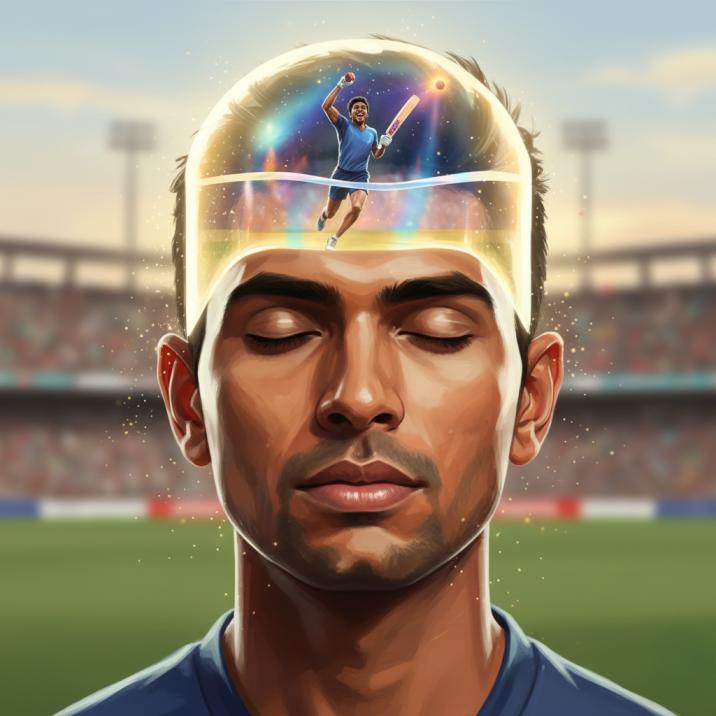
Watch a cricketer just before they walk out to bat. Often, you will see them sitting in the dressing room, eyes closed, bat in hand. They might make tiny, twitchy movements with their shoulders. They aren’t sleeping. They aren’t praying.
They are playing the match before the match has even started.
This is Mental Rehearsal (or Visualization). From Olympic shooter Abhinav Bindra to Virat Kohli, the world’s elite performers know a secret: Your brain cannot tell the difference between a vivid imagination and reality.
As a Sports Psychologist, I teach athletes that you don’t just train your muscles in the gym. You have to train your neurons in the chair.
The Science: “Ghost” Muscles
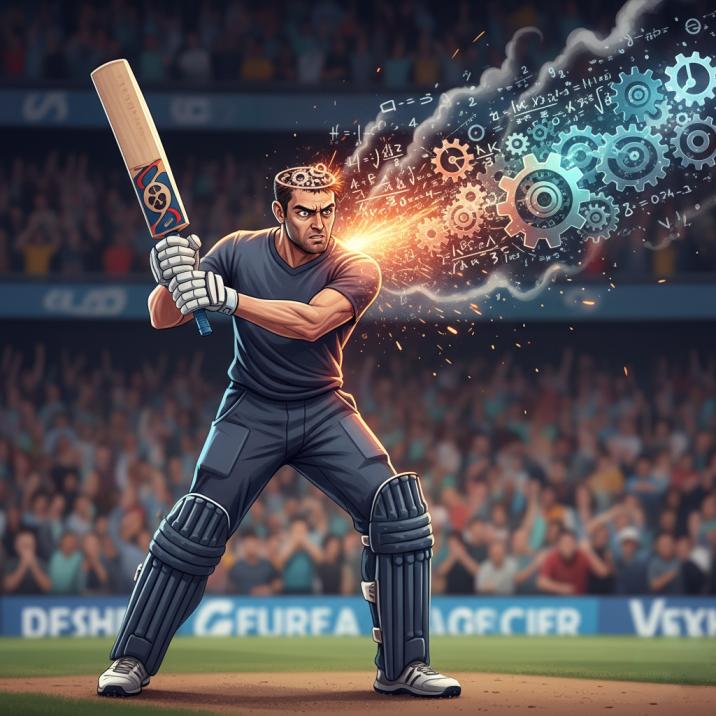
This isn’t spiritual mumbo-jumbo. It is neuroscience. When you physically lift your right arm, a specific part of your brain (the Motor Cortex) lights up. Now, if I ask you to sit perfectly still and vividly imagine lifting your right arm, that exact same part of the brain lights up.
This is called Neuromuscular Facilitation. Your brain sends electrical signals to your muscles, preparing them for the action. It lays down the neural highway so that when you actually step on the field, the path is already paved.
Daydreaming vs. Visualization (The Difference)
Most people get this wrong. They “daydream.”
- Daydreaming: You imagine standing on the podium, holding the trophy, and people cheering. This is just a nice fantasy about the outcome.
- Visualization: You imagine the grit of the bat handle. You feel the sweat on your forehead. You see the ball leaving the bowler’s hand. You feel your feet moving. This is about the process.
To win, you must visualize the sweat, not the trophy.
How to Do It: The “GoPro” Method
We use a framework called PETTLEP. Here is the simplified version you can use tonight.
1. First-Person Perspective (The GoPro View)
Don’t watch yourself like you are watching a movie on TV (Third Person). Visualize from your own eyes. See your hands. See the opponent in front of you. This makes the brain believe you are doing it.
2. Multi-Sensory Detail
A picture is weak. A movie with surround sound and 4D effects is strong.
- Visual: What do you see? (The green grass, the white ball).
- Auditory: What do you hear? (The crowd noise, your own breathing).
- Kinesthetic (Crucial): What do you feel? (The tightness of your shoes, the weight of the racket). The more senses you involve, the more “real” the memory becomes.
3. Real Time, Not Slow Motion
If your speech takes 10 minutes, your visualization should take 10 minutes. Don’t fast-forward the hard parts. Mentally walk through the difficult slides or the tough overs ball-by-ball. This builds Mental Endurance.
4. Visualize the “Error Correction”
Amateurs visualize a perfect game. Pros visualize things going wrong—and then fixing them.
- Imagine missing the first shot.
- Imagine the panic rising.
- Then imagine taking a deep breath, resetting, and hitting the next one. This programs resilience. When you mess up in real life, your brain says, “Oh, we have been here before. I know how to fix this.”
It Works for Everyone (Not Just Athletes)
You don’t need a jersey to use this.
- The Corporate Presentation: Visualize walking into the boardroom. Smell the coffee. See the skeptical face of your boss. Visualize yourself answering his tough question calmly.
- The Student Exam: Visualize walking into the exam hall. Feel the pen in your hand. Imagine turning the paper over and knowing the first answer.
Train Your Mind Gym
Mental rehearsal is a skill. You will be bad at it at first. Your mind will wander. That is okay.
- Sharpen Your Focus (PsychKit): If you can’t hold an image in your head for more than 10 seconds, you need to train your attention span. Use our focus tools to build that mental muscle. Train Your Focus on PsychKit
- Pre-Competition Nerves (VentOut): If the pressure is making you nauseous, visualization might be hard. Talk to a listener first to clear the anxiety fog so you can see the goal clearly. Calm Down Before the Big Day
- Advanced Training (IndianPsychologists): Elite athletes work with Sports Psychologists to create custom visualization scripts recorded to music. If you are serious about your sport, find a specialist. Find a Sports Psychologist
Final Thought
The body achieves what the mind believes. But the mind only believes what it has seen. Show your brain the victory a thousand times in the dark, and it will deliver it once in the light.
📚 References & Further Reading
- Holmes, P. S., & Collins, D. J. – The PETTLEP Approach to Motor Imagery: A Functional Equivalence Model.
- Guillot, A., & Collet, C. – The Neurophysiological Foundations of Mental and Motor Imagery.
- Bindra, Abhinav – A Shot at History (Autobiography detailing his mental training).

Author: JOYSON JOY P' MPhil (Cli. Psy.) Clinical Psychologist
Joyson Joy P is a Clinical Psychologist (RCI Licensed) and the Chief Mentor advisor of the Indian Psychologists Directory & Magazine. With a deep focus on Trauma, Anxiety, Depression, Personality disorders, and Adult ADHD, he bridges the gap between complex psychological science and the Indian cultural context. His mission is to make evidence-based mental healthcare accessible, de-stigmatized, and easy to navigate for every Indian.